Touch Heart's SoundYour pulse is the tempo. Your hand is the melody.Tu pulso es el tempo. Tu mano es la melodía.
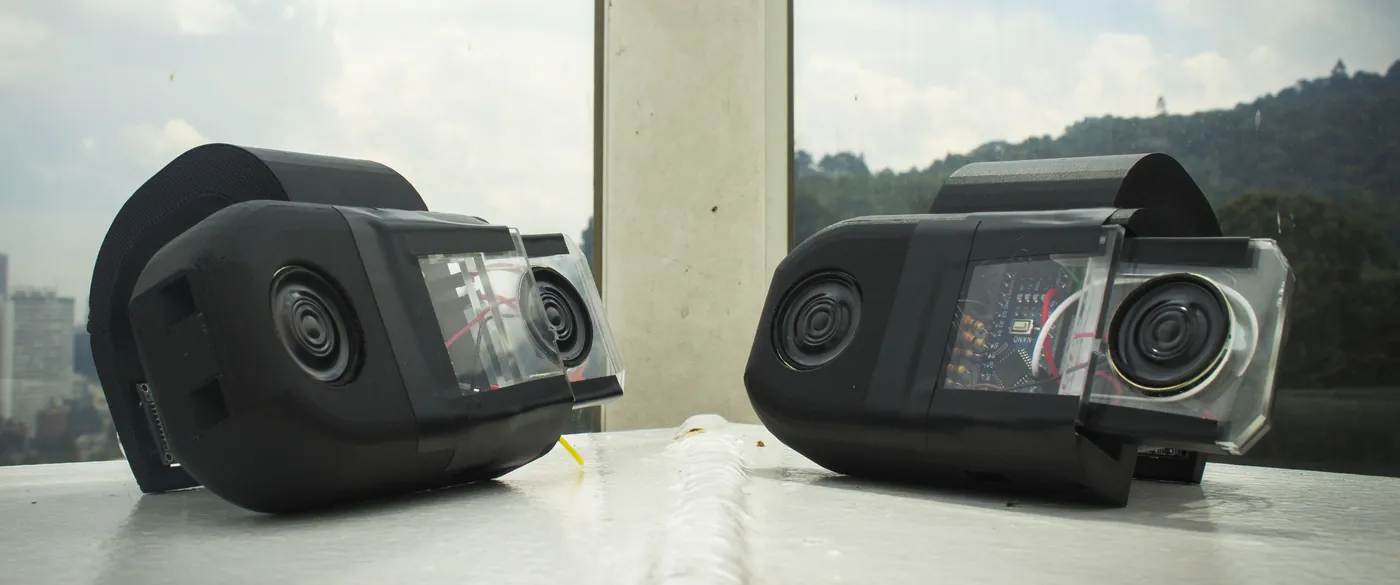
A wearable instrument that listens to your heart. A pulse sensor sets the tempo; an ultrasonic sensor reads how far your hand is from a surface and turns that distance into melody. Bring two of them close and they fall into one rhythm.Un instrumento que se lleva en la mano y escucha tu corazón. Un pulsómetro marca el tempo; un sensor ultrasónico lee qué tan lejos está tu mano de una superficie y convierte esa distancia en melodía. Si acercas dos, encuentran un mismo ritmo.
SpecificationsEspecificacionesTHS · 2022
- YearAño
- 2022, January to May2022, enero a mayo
- ContextContexto
- Faculty of Architecture and Design, Universidad de los AndesFacultad de Arquitectura y Diseño, Universidad de los Andes
- CourseCurso
- Estudio énfasis integrado: Investigación - Proyecto
- ProfessorsProfesores
- Santiago de Francisco Vela · Camilo Ayala García
- TeamEquipo
- Miguel Beltrán · Felipe Lozano Figueroa
- StatusEstado
- Functional prototypePrototipo funcional
- RecognitionReconocimiento
- Selected for the ARQDIS Yearbook No. 04, Universidad de los Andes, 2023Seleccionado para el Anuario ARQDIS N.º 04, Universidad de los Andes, 2023
It startedwith resonance.Empezócon la resonancia.
Resonance is what happens when a wave meets another wave with the same natural frequency: together, they grow in amplitude. We began by studying the resonating chambers of instruments, the guitar, the ukulele, the drum, the Colombian tiple and the Andean bandola, and then asked a stranger question: could sound be perceived through senses other than hearing?La resonancia ocurre cuando una onda se encuentra con otra que tiene su misma frecuencia natural: juntas, crecen en amplitud. Empezamos estudiando las cajas de resonancia de algunos instrumentos, la guitarra, el ukelele, el tambor, el tiple y la bandola andina, y luego nos hicimos una pregunta más extraña: ¿se puede percibir el sonido con sentidos distintos al oído?
The heart became our answer. It is the most personal rhythm we have, and it changes with what we feel. Framed by Positive Design and emotion-based design, we worked with two emotions, impact and stimulus, and one concept: the impact of the stimulus.El corazón se volvió nuestra respuesta. Es el ritmo más personal que tenemos y cambia con lo que sentimos. Desde el Diseño Positivo y el diseño basado en emociones, trabajamos con dos emociones, el impacto y el estímulo, y un concepto: el impacto del estímulo.
Five steps,one heartbeat.Cinco pasos,un latido.
- 01
Heart listeningEscuchar el corazón
The device listens to your heart and sounds once for every beat.El dispositivo escucha tu corazón y suena una vez por cada latido.
- 02
The rhythm settlesEl ritmo se estabiliza
After ten seconds, your beats per minute become the tempo.A los diez segundos, tus latidos por minuto se vuelven el tempo.
- 03
Creating over a surfaceCrear sobre una superficie
Point your hand at a surface and the melody begins.Apunta la mano hacia una superficie y empieza la melodía.
- 04
Height changes the chordLa altura cambia el acorde
Every 30 cm, the arpeggiated chord changes: C major close to the surface, E minor in the middle, G major at the top.Cada 30 cm cambia el acorde arpegiado: Do mayor cerca de la superficie, Mi menor en el medio, Sol mayor arriba.
- 05
SynchronySincronía
Two devices close to each other sync their beats per minute and create together.Dos dispositivos cercanos sincronizan sus latidos por minuto y crean juntos.
LED: green at rest, red once the pulse rises above a resting rate (60 to 75 BPM), as on the device.LED: verde en reposo, rojo cuando el pulso supera el ritmo de reposo (60 a 75 LPM), como en el dispositivo.
Built,
and working.Construido
y funcionando.
A fully functional prototype, worn on the back of the hand. Every part has one job.Un prototipo completamente funcional, que se lleva en el dorso de la mano. Cada parte tiene una sola tarea.
- Pulse sensorPulsómetro
- Reads your beats per minute and sets the tempoLee tus latidos por minuto y marca el tempo
- Ultrasonic sensorSensor ultrasónico
- Measures the distance to a surface and picks the chordMide la distancia a una superficie y elige el acorde
- Arduino Nano
- Runs the logic, on a mini protoboard with its resistorsEjecuta la lógica, sobre una mini protoboard con sus resistencias
- SpeakersBocinas
- Play the beat and the melodyReproducen el latido y la melodía
- LED
- Green at rest, red above a resting rateVerde en reposo, rojo por encima del ritmo de reposo
- HousingCarcasa
- Additive manufacturing, with adjustable strapsManufactura aditiva, con correas de sujeción ajustables
Why create music alonewhen we can resonate together?¿Por qué crear música solossi podemos resonar juntos?
THS asks for technology that helps people learn about themselves while they keep control of what they feel and do. As machines grow more autonomous, it is a small reminder that we are still the ones who create, from what moves us inside.THS propone una tecnología que nos ayude a aprender de nosotros mismos, sin perder el control de lo que sentimos y hacemos. Mientras las máquinas se vuelven más autónomas, es un pequeño recordatorio de que seguimos siendo quienes crean, desde lo que nos mueve por dentro.
- Published inPublicado en
- Convergencias / Divergencias, ARQDIS Yearbook No. 04, Faculty of Architecture and Design, Universidad de los Andes, November 2023, pp. 214–217Convergencias / Divergencias, Anuario ARQDIS N.º 04, Facultad de Arquitectura y Diseño, Universidad de los Andes, noviembre de 2023, pp. 214–217 · DOI
- AuthorsAutores
- Miguel Esteban Beltrán González · Felipe Lozano Figueroa
- ProfessorsProfesores
- Santiago de Francisco Vela · Camilo Ayala García
- PhotographyFotografía
- Miguel Beltrán · Model: Felipe LozanoMiguel Beltrán · Modelo: Felipe Lozano
- AfterwardsDespués
- Teaching assistant for this course for the next three semesters in a row, with Professor Sebastián LondoñoMonitor de este curso durante los tres semestres siguientes, con el profesor Sebastián Londoño
- MoreMás
- Behance · The THS Project